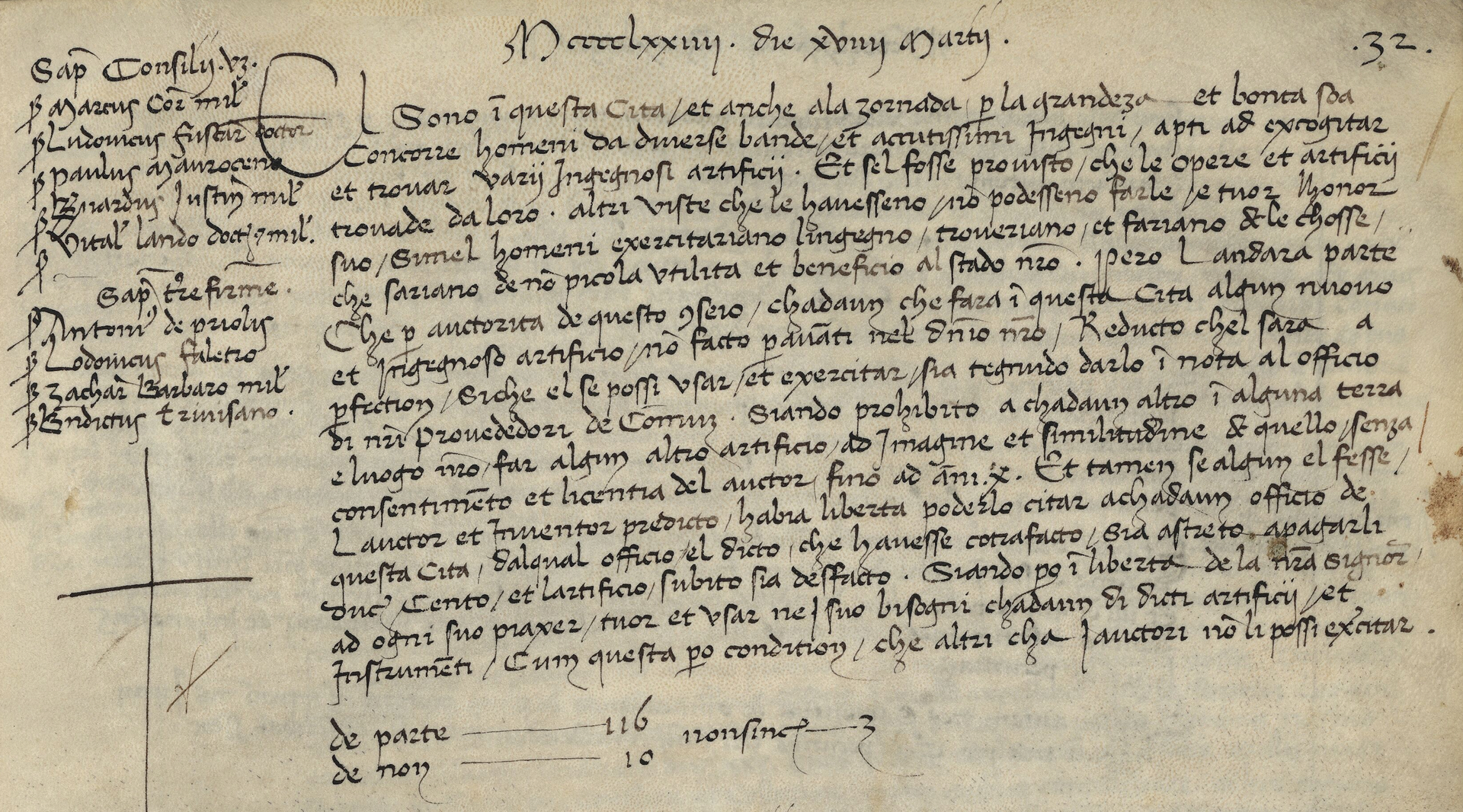
On 19 March 1474 the Senate of the Republic of Venice passed a short act that would echo for more than five centuries. It promised inventors something simple and powerful: if you bring a new, working device to Venice, the state will protect it from copying for ten years. That act, now known as the Venetian Patent Statute, is widely regarded as the first general patent law in history, and its purpose was refreshingly direct: reward the people who create useful things, so that the whole commonwealth grows richer.
Key points
- The Venetian Senate enacted the statute on 19 March 1474, granting ten years of exclusive rights for new and ingenious devices.
- Protection required that the device be new to Venetian territory and “reduced to perfection” so it could actually be used and operated.
- Infringers faced a fine of one hundred ducats and the destruction of the copied device; the state kept a right to use inventions for its own needs.
- Its core ideas traveled through England’s Statute of Monopolies (1624) into the US Constitution and the Patent Act of 1790.
- The statute’s original mandate, rewarding inventors in order to build economic growth, remains the best test of whether a commercialization strategy truly serves the inventor.
Venice in 1474: why a merchant republic needed a patent law
Fifteenth-century Venice was one of the great trading powers of Europe. Its wealth rested on shipping, glassmaking, textiles, printing and a constant flow of skilled craftsmen from across the Mediterranean. The Venetian Arsenal, the state shipyard, was among the largest industrial operations of its age. In such an economy, technical know-how was a competitive asset, and the Venetian government understood that talented people go where their work is respected and rewarded.
Before 1474, European rulers occasionally granted individual privileges to inventors. A frequently cited example is the privilege that the city of Florence granted in 1421 to the architect Filippo Brunelleschi for a vessel designed to carry heavy marble on the river Arno. Venice itself had granted case-by-case privileges. What made 1474 different was that the Senate replaced discretionary favors with a general rule: any inventor who met the conditions could claim protection. That shift from royal grace to legal right is the seed of every modern patent system.
What the statute actually said
The act is short, roughly a single paragraph in the original Venetian dialect. In a widely cited English translation, the Senate explained its reasoning this way:
“We have among us men of great genius, apt to invent and discover ingenious devices; and in view of the grandeur and virtue of our City, more such men come to us every day from divers parts. Now, if provision were made for the works and devices discovered by such persons, so that others who may see them could not build them and take the inventor’s honor away, more men would then apply their genius, would discover, and would build devices of great utility and benefit to our commonwealth.”
That preamble is the heart of the matter. The Senate did not justify patents as a natural property right or a reward for cleverness in the abstract. It justified them as economic policy: protect inventors, attract more of them, and the commonwealth benefits from “devices of great utility.”
The operative provisions
The statute then set out a handful of practical rules. Read in plain English, they look remarkably modern:
| Provision of the 1474 act | What it meant | Modern equivalent |
|---|---|---|
| Applies to any “new and ingenious device” not previously made in Venetian territory | The invention had to be new, at least locally | Novelty requirement |
| Device must be “reduced to perfection so that it can be used and operated” | No protection for bare ideas; the invention had to work | Utility and enablement; reduction to practice |
| Inventor must give notice to the office of the Provveditori di Comun | Registration with a public magistracy | Filing an application with a patent office |
| Ten years of exclusivity in Venetian territory | No one may make a similar device without the inventor’s consent and license | Limited patent term (today generally 20 years from filing) |
| Infringer pays 100 ducats and the copy is destroyed | Real, enforceable remedies before any Venetian magistrate | Damages and injunctions |
| Government may use the devices for its own needs, but only the inventor may operate them | The public interest was reserved | Government-use provisions |
Contemporary transcriptions record that the measure passed by a large majority of the Senate. There was no corps of examiners; registration was simple and disputes went to the magistrates. Yet the essential bargain was all there.
Novelty and usefulness
The statute protected devices that were new to Venice. That was a local standard of novelty: a craftsman who brought a technique from abroad could qualify, because Venice’s goal was to import and grow productive capability. The usefulness requirement was implicit in the phrase “of great utility and benefit to our commonwealth” and explicit in the demand that the device be ready to use.
The working requirement
The phrase “reduced to perfection so that it can be used and operated” deserves attention. Venice was not interested in sketches or speculative claims. Protection began once the device worked. Over the following centuries, many European privilege systems went further and expected the patentee to actually practice the invention within the territory, sometimes within a set time, or risk losing the privilege. Venetian practice in individual grants often reflected the same expectation. The logic was consistent: the public gives a temporary monopoly in exchange for real, working industry at home.
How the Venetian idea traveled
Venetian craftsmen, especially glassmakers and engineers, carried knowledge and expectations across Europe, and rulers elsewhere adopted similar privileges to attract them. Over roughly three centuries the idea matured into national patent laws. The milestones below trace the line from Venice to the modern United States system. For a fuller visual summary, see our patent history timeline.
England’s Statute of Monopolies, 1624
By the early seventeenth century, English monarchs had badly abused the power to grant monopolies, handing exclusive rights over ordinary commodities to favored courtiers. Parliament responded with the Statute of Monopolies in 1624, which declared most monopolies void. Section 6, however, preserved an important exception: letters patent for up to fourteen years could still be granted to “the true and first inventor” of a “new manufacture,” provided the grant was not “mischievous to the state” by raising prices at home or hurting trade.
Notice the continuity with Venice. The statute limited the term, insisted on novelty, focused on manufacture (working industry), and made the public interest a condition. Fourteen years was understood as roughly two cycles of apprenticeship, long enough for an inventor to train others in the new art.
The US Constitution, Article I, Section 8, Clause 8
The framers of the US Constitution wrote the purpose of patents directly into the founding document. Congress was given the power “To promote the Progress of Science and useful Arts, by securing for limited Times to Authors and Inventors the exclusive Right to their respective Writings and Discoveries.” Every element of the Venetian bargain is present: a public purpose (progress), a limited term, and an exclusive right for the inventor. You can read more about the clause on Wikipedia’s page on the Copyright Clause, which covers both patents and copyrights.
The Patent Act of 1790
Congress acted quickly. President George Washington signed the first US Patent Act on 10 April 1790. Applications were reviewed by a board consisting of the Secretary of State (Thomas Jefferson), the Secretary of War and the Attorney General, who could grant a patent for up to fourteen years if they found the invention “sufficiently useful and important.” The first US patent was issued on 31 July 1790 to Samuel Hopkins for a process of making potash, an ingredient in fertilizer and soap. The 1790 act was soon replaced by a simpler registration system in 1793, and the Patent Act of 1836 restored examination and created a dedicated Patent Office.
From national laws to a global system
As trade globalized, so did patents. The Paris Convention for the Protection of Industrial Property (1883) allowed inventors to claim the filing date of their first application when filing in other member countries within twelve months. The Patent Cooperation Treaty (1970) created a single international application route administered through the World Intellectual Property Organization. Today, most patents last 20 years from filing, and agencies such as the United States Patent and Trademark Office handle enormous application volumes.
| Year | Milestone | Term of protection |
|---|---|---|
| 1474 | Venetian Patent Statute | 10 years |
| 1624 | Statute of Monopolies (England), Section 6 | Up to 14 years |
| 1787 | US Constitution, Art. I, Sec. 8, Cl. 8 | “Limited times” |
| 1790 | First US Patent Act | Up to 14 years |
| 1883 | Paris Convention | 12-month priority right |
| 1970 | Patent Cooperation Treaty | International filing route |
| Today | Most national systems | Generally 20 years from filing |
What has changed since Venice
The modern patent system is vastly more complex than a one-paragraph act and a registration book. Some changes are clear improvements: published patents now teach the public in detail, examination filters out many weak claims, and international treaties make cross-border protection practical. Other changes, in our view, have pulled the system away from its original purpose.
- Volume and complexity. Beginning in the 1980s, the rise of computing and software dramatically increased both the number of applications and the difficulty of examining them. Patent offices have struggled to keep up, and pendency and cost have grown accordingly.
- Cost of enforcement. A Venetian inventor could bring a copier before a magistrate. A modern independent inventor facing a well-funded infringer may confront litigation costs that are simply out of reach.
- Post-grant challenges. Since the America Invents Act, patents can be challenged at the Patent Trial and Appeal Board. Supporters see this as quality control; many independent inventors see it as an added burden. We examine both sides in our article on the America Invents Act and independent inventors.
- Concentration of market power. In many technology sectors a few dominant firms control distribution, standards and customer access. From this site’s perspective, that concentration means a patent alone rarely guarantees that the inventor, rather than an acquirer, captures the value of an invention.
The original mandate in one sentence: Venice granted inventors a temporary exclusive right so that more people would build working devices “of great utility and benefit to our commonwealth.” The reward to the inventor and the growth of the economy were meant to go together, not to be traded against each other.
Why the pure purpose matters for today’s inventors
It is easy to treat a patent as the finish line. The Venetian statute reminds us that it was never meant to be. The Senate protected devices that were already “reduced to perfection,” and it did so because those devices were expected to be used, generating work, trade and taxes. A patent sitting in a drawer did nothing for Venice, and it does little for an inventor today. Commonly cited estimates suggest that only a small percentage of patents ever achieve meaningful commercial success; we discuss the reasons in why most patents fail commercially.
Three lessons follow directly from the 1474 text:
- Ideas are not enough. Venice protected working devices, not concepts. Ideas are cheap until they are developed into a prototype that proves the invention works. That is also what persuades investors and partners.
- The goal is use, not merely ownership. The value of a patent is realized when the invention reaches the market at scale. Strategy should be designed around reaching that market, not just around obtaining the grant.
- The inventor should share in the growth. The statute’s logic collapses if inventors are routinely stripped of the value they create. When the dominant path to market leaves the inventor with a small fraction of the value, more people stop applying their genius, exactly as the Venetian Senate warned.
From the 1474 mandate to Pre-Patent Pre-Partnering
The Pre-Patent Pre-Partnering approach promoted on this site is, at its core, an attempt to restore the Venetian balance. Rather than building a startup primarily to become attractive for a takeover by a dominant firm, the inventor’s company sets a realistic business strategy for its industry early, before going to market, and then seeks a suitable, intrigued and committed major partner when the project is ready. The partner brings manufacturing, distribution and market access; the inventor brings the working invention, the know-how and the protected rights. Both share in the growth.
This idea grew out of years of volunteer advocacy by the site’s founder, Amnon, a retired businessman and inventor who served as the first lobbyist for the regional inventors society in his Canadian province. In that role he met leaders from government, industry and education, including the USPTO, and prepared proposals such as the “Pre-patent Registry and silent Trading-Post” and the “Super Economy” concept. The common thread is the Venetian one: a patent system works best when it rewards inventors in a way that also builds the wider economy.
Of course, pre-partnering is not the only path. An inventor who is confident in the market and not threatened by IP piracy or infringement may go to market alone or with an investor. The point is to choose deliberately. Our step-by-step Pre-Patent Pre-Partnering guide walks through how to decide and how to prepare.
Educational content, not legal advice. Patent rights, deadlines and disclosure rules vary by country and change over time. Before filing or disclosing an invention, consult a registered patent attorney or agent about your specific situation.
Put the original mandate to work for your invention
The Venetian Senate asked a practical question in 1474: how do we get more useful inventions built and used? Every inventor should ask the same question before spending heavily on patents. If you would like to talk through how the Pre-Patent Pre-Partnering approach could apply to your invention, explore our services or contact us by email at [email protected] to arrange a first conversation.