Water is heavy, sticky and relentless. Every ship that crosses an ocean spends a large share of its fuel simply dragging its hull through it. For more than a century, naval architects have searched for ways to make that contact less costly. One of the most intriguing answers is also one of the simplest to describe: put a layer of air between the hull and the sea. Air lubrication has moved from laboratory curiosity to commercial installations, and it offers a revealing case study in how maritime innovations succeed or stall. It is also the field in which this site’s sponsoring corporation, Superior Hulls Inc., is working.
Key points
- Frictional resistance between hull and water is a major component of a ship’s total resistance, especially for large, slow vessels.
- Air lubrication introduces air under the hull to reduce the wetted contact area and the friction it causes.
- IMO energy efficiency rules (EEDI, EEXI and CII) give shipowners strong regulatory reasons to adopt proven efficiency technologies.
- The maritime market is conservative, capital-intensive and dominated by large players, which makes going it alone very difficult for an inventor.
- Superior Hulls Inc. is pursuing an injected-air approach and seeking a wise major maritime partner, an example of the Pre-Patent Pre-Partnering approach in practice.
The problem: why hulls waste energy
Naval architects break a ship’s resistance into components. The two most important are wave-making resistance, the energy spent creating the wave system a ship leaves behind, and frictional (viscous) resistance, the drag created as water shears along the hull’s wetted surface. The English engineer William Froude laid much of the foundation for this analysis in the nineteenth century with his towing-tank experiments, and the separation of resistance into frictional and residual parts remains central to ship design today.
For fast, slender craft, wave-making can dominate. For large, slow, full-bodied ships such as tankers, bulk carriers and many container ships, frictional resistance is commonly described as the largest single component. These are exactly the ships that burn the most fuel worldwide. Reducing friction on them, even modestly, has a large cumulative effect on cost and emissions.
Traditional tools for reducing friction include smooth hull coatings, antifouling paints that prevent marine growth, and regular hull cleaning. These are valuable, but they work on the quality of the wetted surface. Air lubrication tackles the wetted surface itself.
The concept: separating hull from water with air
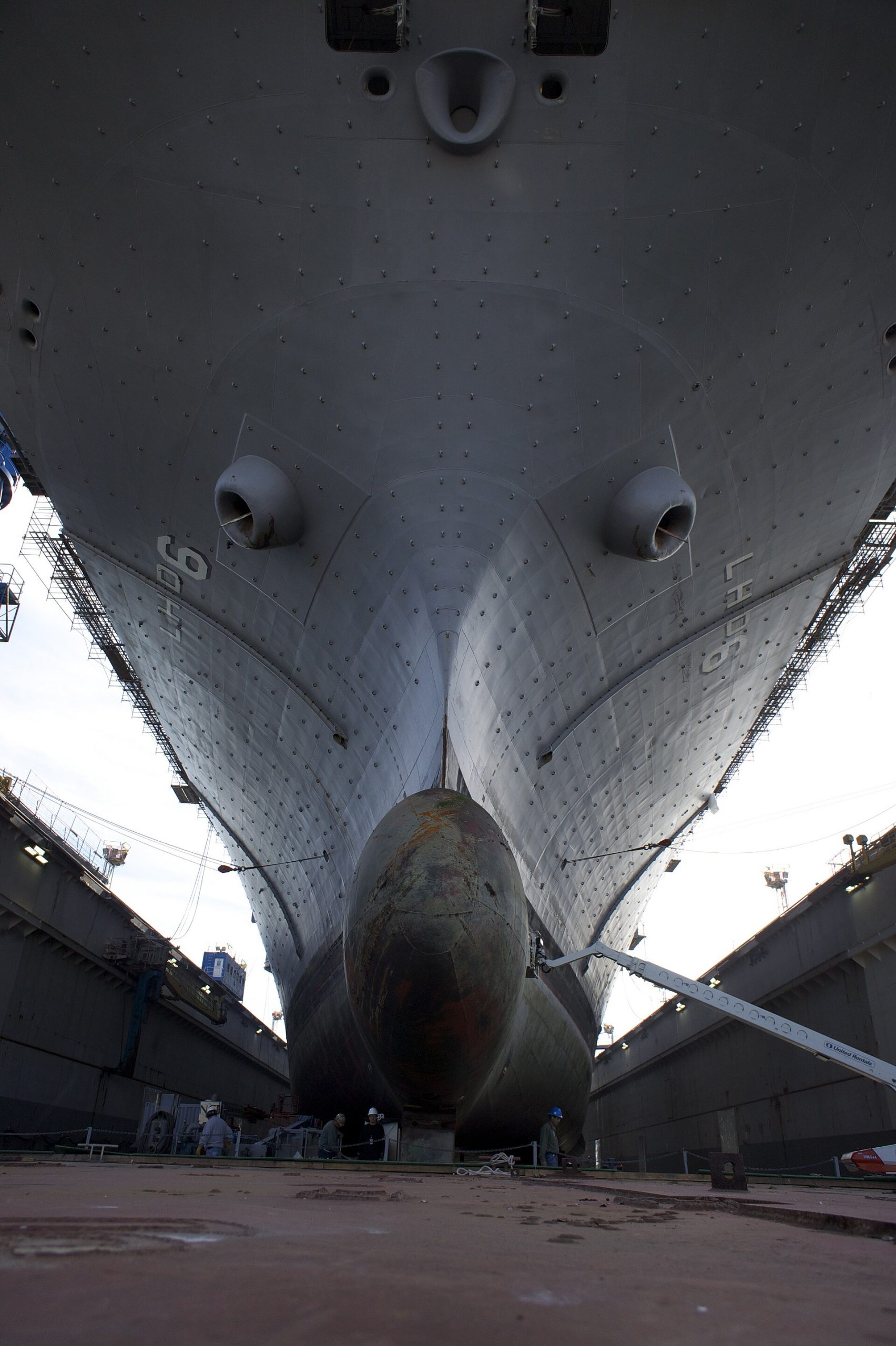
Air is roughly eight hundred times less dense than water and far less viscous. If part of the hull’s flat bottom is in contact with air rather than water, the shear forces on that part fall sharply. The engineering challenge is to keep the air where it is useful, at an energy cost lower than the energy saved.
Three broad approaches
- Bubble lubrication: small bubbles are injected into the boundary layer near the hull, modifying the flow and reducing friction.
- Air layer lubrication: a larger flow of air forms a more continuous film beneath the flat bottom of the hull.
- Air cavity systems: recesses built into the hull bottom are filled with air, creating stable pockets that reduce wetted area.
Each approach involves trade-offs among air-supply power, stability of the air layer in waves and turns, effects on propeller performance, structural changes to the hull and suitability for new builds versus retrofits. Systems from several marine technology suppliers have been fitted to commercial vessels, including cruise ships, gas carriers and cargo ships, and the concept is now widely discussed in the industry as one of several technologies for improving energy efficiency.
An old idea that needed its moment
The idea of reducing a hull’s friction with air is not new. Engineers and inventors proposed variations of it from the nineteenth century onward, and researchers in several countries studied bubble and air-layer drag reduction in laboratories and test basins over many decades. For much of that time, the concept struggled to cross from experiment to routine commercial use. Fuel was relatively cheap, efficiency regulation was weak, and the engineering of reliable air-supply systems on large ships was demanding.
That pattern will be familiar to readers of our article on the electric car paradox: a sound physical principle can wait a long time for the economics, the regulations and the supporting technology to catch up. What changed for air lubrication was a combination of higher fuel costs, better compressors, controls and computational tools, and, above all, binding international efficiency rules.
The regulatory driver: IMO energy efficiency rules
Technologies like air lubrication matter more today because the regulatory environment has changed. The International Maritime Organization (IMO), the United Nations agency responsible for the safety and environmental performance of international shipping, has adopted a series of energy efficiency measures under Annex VI of the MARPOL convention:
| Measure | What it does | In force |
|---|---|---|
| EEDI (Energy Efficiency Design Index) | Sets minimum design efficiency standards for new ships, tightened in phases | Mandatory for new ships from 1 January 2013 |
| SEEMP (Ship Energy Efficiency Management Plan) | Requires an operational plan for managing a ship’s energy efficiency | From 1 January 2013, later strengthened |
| EEXI (Energy Efficiency Existing Ship Index) | Applies design-efficiency requirements to existing ships | From 1 January 2023 |
| CII (Carbon Intensity Indicator) | Rates a ship’s annual operational carbon intensity from A to E | From 1 January 2023 |
In 2023 the IMO also adopted a revised greenhouse gas strategy that aims for net-zero emissions from international shipping by or around 2050. IMO guidance on innovative energy efficiency technologies addresses how measures such as air lubrication can be reflected in efficiency calculations. For shipowners, this means efficiency is no longer only a matter of fuel savings; it affects compliance, ratings, charter attractiveness and the long-term value of their fleets. For background on the organization itself, see the overview of the International Maritime Organization.
The sponsor’s approach: Superior Hulls Inc.
This site is sponsored by Superior Hulls Inc. (Canada/Israel), a maritime innovation company. Superior Hulls describes its work as a new science of controlled collision between solid bodies and fluid bodies, using injected air under hulls to improve economy, performance, comfort, safety and speed. The company states that it is seeking a wise major maritime partner to bring the technology forward. More information is available on the company’s own website, superiorhulls.com.
We mention the sponsor not to make claims about results, which only testing and a partner’s validation can establish, but because its strategy illustrates the central argument of this site. Superior Hulls has chosen not to try to break into shipbuilding alone. It is looking for the right partner first.
Why the maritime market is hostile to lone inventors
Few industries are as difficult for an independent inventor to enter directly as commercial shipbuilding. Consider the barriers:
- Capital intensity: a single test installation can require dry-dock time, structural modifications, compressors, piping and control systems on a vessel worth many millions of dollars.
- Long asset lives: ships typically operate for decades, so owners are cautious about modifications that could affect reliability or resale value.
- Classification and safety approval: classification societies and flag administrations must be satisfied that changes are safe. Approval takes engineering documentation, time and credibility.
- Proof requirements: owners want sea-trial data from comparable vessels before committing. Without access to ships, an inventor cannot generate that data.
- Concentrated buyers and builders: a relatively small number of large shipyards, owners and operators shape what gets adopted.
- IP exposure: once a hull concept is visible in a dry dock or described in a technical paper, it can be studied and imitated by companies with far greater resources.
An inventor who tries to fight through all of these barriers alone risks running out of money long before the first commercial order, or seeing a well-funded competitor commercialize a similar concept first. This is the kind of hostile market the site’s core message warns about.
Why a wise major partner changes the equation
The Pre-Patent Pre-Partnering approach holds that, when a project is ready for market, the inventor’s company should search for a suitable, intrigued and committed major partner rather than striving to be attractive for a takeover. In the maritime context, a major partner might be a shipyard, a ship operator, a marine equipment manufacturer or an engineering group with a fleet relationship. Such a partner can supply:
- Test platforms: real hulls for model and full-scale trials.
- Engineering depth: naval architects and systems engineers to integrate the technology safely.
- Regulatory pathways: established relationships with classification societies and flag states.
- Market credibility: a trusted name that owners will listen to.
- Manufacturing and service: the ability to install and maintain systems worldwide.
- Enforcement strength: the resources to defend patents against imitation.
The word “wise” matters. The right partner is not simply the largest company. It is one whose strategy benefits from the technology’s success, which will commit resources rather than shelve the idea, and which respects the inventor’s contribution through a fair structure, whether an exclusive field-of-use license, a joint venture or another arrangement. Our articles on finding the right major partner and choosing a deal structure go into those choices.
What a maritime partnering proposal should contain
A major shipyard or operator receives many unsolicited ideas. To stand out, an inventor’s company should present a disciplined, partner-ready package:
- A clear statement of the problem solved and the vessel types that benefit most.
- The current state of intellectual property protection, described accurately and without overstating its scope.
- The evidence available so far, such as calculations, simulations or scale-model results, with their limitations stated honestly.
- A proposed validation program: what tests are needed next, on what kind of vessel, and at what approximate cost.
- The partner’s expected role and benefit, including how the technology supports its own efficiency and compliance goals.
- A flexible view of deal structures, from licensing to joint development.
Confidentiality should be addressed before technical details are shared, typically through a non-disclosure agreement reviewed by counsel.
Lessons for inventors in any heavy industry
The air lubrication story applies well beyond ships. Aerospace, rail, energy, mining and medical devices share similar features: expensive validation, safety regulation, conservative buyers and dominant incumbents. Inventors in these sectors should:
- Protect the core invention carefully before public disclosure; see protecting your idea before the patent.
- Generate the best evidence they can afford, such as models, simulations and small-scale prototypes.
- Map the industry’s decision-makers and identify which ones gain the most from adoption.
- Understand the regulatory drivers that make the invention timely.
- Approach potential partners with a clear, realistic proposal rather than a demand for a buyout.
As always, this article is educational and not legal or engineering advice. Consult a registered patent attorney or agent and qualified marine engineers for decisions about a specific technology.
Are you a maritime company interested in hull efficiency innovation, or an inventor facing a hostile industry? We welcome serious inquiries. Contact us by email to begin the conversation.